
Why Most Resumes Get Rejected in 6 Seconds (And How to Fix Yours)
Recruiters spend 6-7 seconds on a resume. Here's why yours gets rejected, what they look for, and how to fix every common mistake fast.
Introduction
Updated March 2026
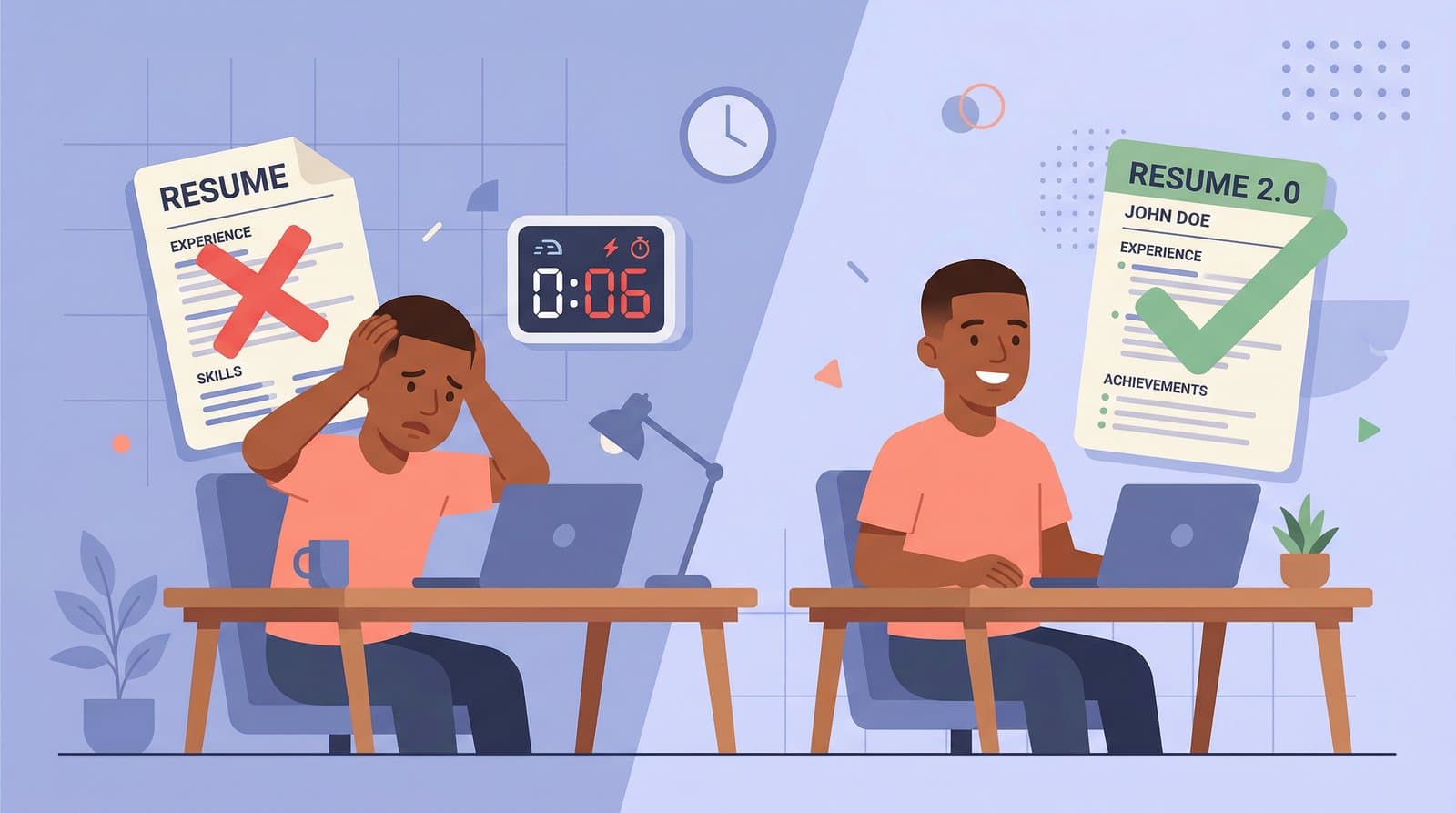
Six seconds.
That's the number everyone quotes, and it's not far off. TheLadders' eye-tracking study found the average initial scan lasted 7.4 seconds, and a more recent analysis by InterviewPal in 2025 put the average at 11.2 seconds, though that measured recruiters using structured review tools side-by-side with job descriptions.
By Sarah Chen, Career Strategy Lead at PrettyResume | Updated March 2026
We've reviewed thousands of resumes through PrettyResume's scoring tool, and the pattern is consistent: most resumes fail in the first few seconds, not because the candidate is unqualified, but because the document doesn't communicate fast enough.
Even in the most generous measurement, recruiters make an initial decision on your resume in under fifteen seconds. In high-volume hiring scenarios (entry-level roles, popular companies, remote positions) the time drops closer to the lower end.
But here's what most job seekers miss: most resumes don't even make it to a human. Before a recruiter ever sees your document, it passes through an Applicant Tracking System (ATS) that ranks it against hundreds of others. The ones that rank low may never surface in a human's queue. If you want to understand exactly how these systems work, our guide to ATS software breaks down the full process.
Your resume faces two audiences: an algorithm and a person. It's probably failing one of them. Maybe both. This guide explains exactly why, and what to do about it.
The 6-Second Reality: What Recruiters Are Actually Looking At
An eye-tracking study published by InterviewPal identified exactly where recruiters' attention goes in those first seconds:
- 38% of gaze time lands on the Experience section
- Name and current title, checked immediately
- Company names, scanned for recognizable employers
- Dates, assessed for gaps and total tenure
- One or two top bullet points, scanned for impact words and relevance
They're not reading. They're pattern-matching. The question in their head is simple: "Does this person have the right experience, have they been in credible environments, and does this look relevant to what I need?"
Three things cause instant rejection in the first pass:
- Dense, wall-of-text formatting (hard to scan, recruiter moves on)
- Unclear or irrelevant top bullet points
- A profile that doesn't match the role
The same InterviewPal study found that dense text blocks caused rejection 43% of the time, missing or unclear job titles caused rejection 31% of the time, and over-decorated templates that confused the scan path caused 18%.
Reason 1: Your Formatting Is Working Against You
Most people format their resume to impress. Two columns look organized. Icons for contact info look modern. A custom color scheme shows personality.
ATS systems hate all of it.
The algorithm problem: Multi-column layouts cause ATS parsers to read your resume in the wrong order, combining content from separate columns into garbled sentences. Text boxes aren't extracted at all in many systems. Graphics cause parsing failures that can effectively delete entire sections from the system's record of your document.
The human problem: Even if a complex layout survives the ATS, Recruiting Headlines research found that 72% of recruiters cite poor formatting (inconsistent fonts, misaligned elements) as a reason for rejection. Paradoxically, the resume that tries hardest to look distinctive often fails the fastest.
In our experience, candidates from design and marketing backgrounds fall into this trap most often. That beautiful Canva template? It might score a 30 out of 100 in an ATS. We see it constantly in PrettyResume's scoring tool.
The fix: Single column. Standard fonts (Arial, Calibri, Georgia). Clean section headers with plenty of white space. Your goal is a document that can be scanned left-to-right in under 10 seconds and communicates your value without effort. This approach works for most roles, though creative fields applying directly to a design team might have more flexibility.
Reason 2: You're Not Using the Right Keywords
Here's a counterintuitive fact: you can be perfectly qualified for a job and have your resume filtered out, not because you lack the skills, but because you described them using different words than the job description uses.
An analysis by EDLIGO of 1,000 rejected resumes found that 43% of rejections were caused by formatting, parsing, or keyword mismatch issues, not by lack of qualifications. The candidate was right for the job; the resume failed the filter.
ATS systems do keyword matching. If the job posting says "React.js" and your resume says "React," many systems don't treat these as equivalent. If the posting says "data analysis" and you wrote "analytics," you may score lower. One word can make the difference. For a deeper dive into beating these systems, read our complete guide to beating ATS systems in 2026.
The fix: Read the job description carefully before each application. Mirror the exact language used for key skills, tools, and technologies. Use both the acronym and full form where relevant ("Search Engine Optimization (SEO)"). The tailored resume doesn't require a full rewrite; it requires 20 minutes of targeted keyword alignment.
Huntr's job search data confirms that tailored resumes achieve a 5.95% interview rate compared to 2.9% for generic resumes. That's more than double, from a 20-minute investment.
Reason 3: Your Bullet Points Describe Duties, Not Achievements
Open most resumes and you'll see some version of this:
- Responsible for managing social media accounts
- Assisted with product development
- Supported the sales team
I've reviewed hundreds of resumes, and these duty-based bullets are the single most common weakness I see. They describe what your job description said, not what you actually accomplished. They're interchangeable between candidates. They give a recruiter zero reason to advance you over the next person.
The research backs this up: resumes with quantified achievements have up to a 40% higher chance of earning an interview, according to Resume-Now's statistics. Despite this, only 8% of resumes actually include numerical data. That gap is an opportunity for you.
The fix: For every bullet, ask: "What did this lead to? What changed because of my work?" Then put the answer in the bullet.
| Before | After |
|---|---|
| Managed social media accounts | Grew Instagram following from 4,200 to 31,000 over 14 months by implementing a consistent content calendar and engagement strategy |
| Assisted with product development | Conducted 22 user interviews that surfaced three critical UX blockers, leading to a redesign that improved checkout completion rate by 18% |
| Supported the sales team | Built a prospecting database of 800 qualified leads, contributing to $340K in new pipeline in Q3 |
You don't need a metric for every single bullet. But most experienced professionals have at least 3 to 5 quantifiable accomplishments in their recent history that they're not including. Based on resumes analyzed through our platform, adding even two or three numbers to your top bullets can push your resume score up significantly.
Reason 4: Your Resume Is Generic
The average corporate job posting attracts 250 applicants, per Resume-Now. Of those, only 2% are invited to interview. The math is brutal. Your resume isn't competing for attention; it's competing in a race where the vast majority of entries are disqualified before the start.
A generic resume that was built once and submitted to 50 jobs will consistently underperform a tailored resume because:
- It won't match the specific keyword profile of each job description
- It won't emphasize the most relevant experience for each role
- It signals to both the ATS and the recruiter that you didn't invest effort in this specific application
We've seen candidates go from zero callbacks to multiple interviews in a single week just by tailoring their resume to each posting. The difference is that dramatic. An AI resume builder can cut tailoring time significantly while maintaining the quality that gets results.
The fix: Use a master resume with all your experience and achievements. For each application, create a targeted version: update your professional summary to reflect the role, reorder your skills to match the posting's priorities, and move your most relevant experience to the top of your bullets.
Reason 5: Small Mistakes That Cause Instant Rejection
Some resume rejections have nothing to do with your qualifications or formatting strategy. Recruiting Headlines surveyed recruiters and found:
- 76% will reject a resume for lies or exaggerations
- 72% will reject for poor formatting (inconsistent fonts, alignment)
- 68% will reject for typos
- 61% will reject for an unprofessional email address
An email like rockstar_coder_99@hotmail.com or jennifer_smith1987@aol.com creates a negative impression before a recruiter reads a word of your experience. Use firstname.lastname@gmail.com or a professional domain. Small detail. Huge impact.
According to Resume-Now's data, job seekers with 99%+ correctly spelled words are three times more likely to be hired. Spellcheck alone is not sufficient; it doesn't catch "manger" instead of "manager" or "costumer" instead of "customer."
The fix: Use a professional email. Proofread carefully. Read your resume aloud; it's the most reliable way to catch awkward phrasing and errors that look fine on screen. This won't guarantee success for every industry or every role, but it eliminates the easiest reasons to get rejected.
Reason 6: You're Applying the Wrong Way
Even a perfect resume performs poorly if it enters the ATS at a disadvantage.
The Interview Guys note that resumes submitted within 48 hours of a job posting often get priority in ATS queues. Wait too long and you're competing with a saturated pool. Timing matters more than most people realize.
On top of that, applying through third-party aggregators like Indeed or ZipRecruiter sometimes creates an extra parsing layer that can corrupt formatting. Applying directly through a company's career portal is generally more reliable.
The fix: Set up job alerts and apply early. Apply through company career portals when possible. Follow application instructions precisely, including file format requests.
The Fix: Check Your Resume Before You Apply
The single highest-impact action you can take before your next application is to run your resume through a resume score checker. These tools simulate how ATS systems will rank your document against a specific job description, identifying:
- Which keywords are missing
- Which formatting elements will cause parsing problems
- Which bullet points are vague rather than achievement-focused
- Your overall match score for the role
Scale.jobs data shows that candidates with ATS scores above 80% receive 3x more interview requests than those below 60%. Checking your score before submitting takes 5 minutes and changes your odds significantly.
PrettyResume includes a Resume Score feature that runs this analysis automatically as you build. Paste the job description, and the tool shows you exactly what's missing and what to fix, in real time, before you apply.
Fix your resume with PrettyResume's Resume Score - free
The 10-Minute Resume Audit
If you want to quickly assess your current resume, run through this checklist:
Formatting (2 minutes)
- Single column, no sidebars or two-column layout
- No photos, icons, or graphics
- Standard section headers (Work Experience, Education, Skills)
- Standard, readable font
- Consistent dates and formatting throughout
Keywords (3 minutes)
- Open the job description side by side
- Find 5 required skills, are they all in your resume?
- Are you using the posting's exact terminology for key tools/skills?
Content (3 minutes)
- Does your professional summary mention the role title and your strongest relevant qualification?
- Do your top 3 bullets include a number or quantified outcome?
- Does your email address look professional?
Presentation (2 minutes)
- Read the first 5 lines aloud, does it sound like a qualified, relevant candidate?
- Any typos in the top third of the document?
If you found multiple issues in this audit, your resume is likely being filtered or deprioritized in a significant percentage of your applications. The good news: most of these fixes take minutes, not hours.
Related Articles
- How to Beat ATS Systems in 2026: The Complete Guide
- Resume Score Checker: How to Know If Your Resume Will Get Past ATS
- AI Resume Builder vs. Writing Your Own: Which Gets More Interviews?
- Your Resume Passed ATS. Now What? How to Impress the Human Recruiter
Frequently Asked Questions
Why do recruiters only spend 6 seconds on a resume?
Volume. That's the short answer. The HR Gazette research found entry-level roles average 400 to 600 applicants, and some remote or popular roles exceed 1,000 in the first week. With that volume and limited time, recruiters pattern-match quickly: does this look relevant? Does the top third signal the right experience? They dive deeper only on resumes that pass that initial filter.
Does my resume actually get rejected by a robot?
Not exactly, but effectively, yes. ATS systems rank resumes rather than flat-out rejecting them. Poorly ranked resumes are buried in a recruiter's queue. With hundreds of applications per role, recruiters rarely reach the bottom of the list. The result is the same as a rejection: your application is never seen. EDLIGO's analysis found 43% of resume rejections stem from formatting and keyword issues rather than lack of qualifications.
How do I fix a resume that keeps getting rejected?
Start with a resume score check to identify the specific problems. PrettyResume's ATS analysis feature can pinpoint exactly where your resume falls short. The most common fixable issues are: keyword gaps (you have the skills but aren't using the right terminology), formatting problems (columns or graphics confusing ATS parsers), and vague bullet points without quantified achievements. Address these three areas and you'll see a noticeable improvement. Results vary depending on your industry and the competitiveness of the roles you're targeting, but we've found that fixing these fundamentals makes a real difference for the majority of job seekers.
Should I use a resume template from a free website?
Only if it's specifically ATS-tested. Many visually attractive templates on sites like Canva or Pinterest use multi-column layouts, text boxes, or graphics that cause ATS parsing failures. According to SHRM, over 98% of Fortune 500 companies use some form of ATS. If you're applying to companies that use these systems (virtually all companies over 50 employees), prioritize ATS compatibility over visual design.
How many jobs should I apply to per week?
More than most people think, but quality matters as much as quantity. The Interview Guys note that only 2 to 3% of applications lead to interviews in 2026. To generate 2 to 3 interviews per week, you may need to submit 70 to 100 tailored applications. AI resume builders make this more achievable by reducing tailoring time from 2 hours to 15 to 20 minutes per application.