
Resume Score Checker: How to Know If Your Resume Will Get Past ATS
A resume score checker tells you how your resume performs against ATS before you apply. Learn how scoring works and how to improve yours.
Introduction
Updated March 2026
Sending a resume without checking its ATS score is like publishing a website without testing whether it loads. You did the work, sure. But you have no idea how it's actually performing on the other side.
By Sarah Chen, Career Strategy Lead at PrettyResume | Updated March 2026
We've reviewed thousands of resumes through PrettyResume's scoring tool, and the pattern is always the same: candidates assume their resume is fine, run a score check, and discover they're missing 30% or more of the keywords a recruiter's system is looking for. A resume score checker fixes that blindspot. It analyzes your resume against a target job description and tells you, with a specific number, how well you'll rank in the Applicant Tracking Systems most employers use to filter applications. Not vague advice like "tailor your resume more." A concrete score with concrete gaps.
This guide explains how resume scoring works, what the numbers actually mean, and how to use a score checker to improve your resume before your next application.
What Is a Resume Score?
A resume score is a numerical rating, typically on a 0 to 100 scale, that estimates how well your resume matches a specific job description from an ATS's perspective.
Think of it as a compatibility percentage. The score is calculated by analyzing several dimensions simultaneously:
- Keyword match rate: How many of the job description's required skills, technologies, and phrases appear in your resume
- Formatting compatibility: Whether your resume's structure will parse cleanly through ATS software
- Section completeness: Whether all standard resume sections are present and properly labeled
- Content quality signals: Presence of quantified achievements, appropriate length, strong action verbs
- Hard filter compliance: Whether your resume meets baseline requirements (years of experience, education credentials)
Different tools weight these factors differently, but the core logic is consistent: the score represents how similar your resume looks to an "ideal" candidate for that specific role, as seen through algorithmic eyes. If you want a deeper understanding of how these systems work under the hood, our guide to ATS software covers the full process.
How ATS Scoring Works in Practice
Here's what most people don't realize. When you apply to a job at a company using ATS, your resume enters a queue with hundreds of other applications. The ATS doesn't just store them; it ranks them. Recruiters typically see the highest-ranked resumes first, and many never scroll past the top 20 to 30 candidates.
Your resume's rank is determined by its match score against the job description. According to Scale.jobs, candidates with ATS scores above 80% receive 3x more interview requests than those below 60%. That gap isn't marginal. It's often the difference between appearing in a recruiter's queue and never being seen at all.
Here's a simplified breakdown of how scoring thresholds typically translate:
| Score Range | Typical Outcome |
|---|---|
| 90 to 100% | Excellent, surfaces near top of recruiter queue |
| 80 to 89% | Strong, high probability of human review |
| 70 to 79% | Adequate, likely reviewed but lower priority |
| 60 to 69% | Weak, may be filtered or buried in queue |
| Below 60% | At risk, often filtered before human review |
These aren't official cutoffs, and every ATS (Workday, Greenhouse, Lever, and the rest) has different parameters. But based on resumes analyzed through our platform, they represent a reliable general framework for how recruiters typically configure their scoring thresholds.
What a Resume Score Checker Analyzes
A quality resume score checker does more than spit out a percentage. It breaks down exactly where your score comes from and what's dragging it down. Here's what the best tools look at:
Keyword Coverage
This is the single most impactful factor. The checker compares the specific words in your resume against the language in the job description. It identifies:
- Required skills you have but aren't explicitly listing
- Technologies mentioned in the posting that you're missing
- Job title variations that don't match how the ATS is searching
- Industry-specific terminology gaps
An analysis from EDLIGO found that only 34% of ATS systems support semantic matching (recognizing that "ML" means "machine learning"). In our experience, this means exact keyword alignment matters far more than you'd expect in what should be a modern system. Don't assume the software will connect the dots for you.
Formatting and Parsing Compatibility
The checker simulates how an ATS parser would read your file. It flags:
- Tables and multi-column layouts that cause parsing failures
- Text boxes and graphics that confuse extraction
- Non-standard section headers that the ATS won't recognize
- File format issues
These formatting problems are among the most common reasons resumes get rejected, often before a recruiter ever sees them.
Achievement Quality
Beyond keywords, quality checkers evaluate whether your experience bullets include quantified achievements. Resume-Now's data shows resumes with hard metrics have up to a 40% higher interview chance, yet only 8% of resumes include numerical data. That's a staggering gap. A score checker can flag bullets that are vague responsibility descriptions rather than real achievement statements.
Contact and Structure Completeness
Checkers verify that all standard resume components are present: contact information, professional summary, work experience, education, and skills section. Missing sections are easy wins. We've seen candidates boost their score by 10 or more points just by adding a skills section they'd left out.
How to Use a Resume Score Checker Effectively
Step 1: Choose a Job Description to Target
A resume score is always relative to a specific role. Before running a check, have the full job description text ready. The more complete the posting you use, the more accurate the analysis. Copy the whole thing, not just the requirements list.
Step 2: Upload Your Current Resume
Most checkers accept PDF or .docx files. Use a text-based PDF (not a scan) or a Word document without complex formatting for the most accurate parsing simulation.
Step 3: Review the Score Breakdown
Don't stop at the overall percentage. That number alone is almost useless without context. Look at:
- Which specific keywords are missing
- Which formatting issues were flagged
- Which sections are incomplete or weaker
- Which achievement bullets are flagged as vague
Step 4: Make Targeted Improvements
Prioritize keywords first; they have the highest impact on your score. Then address formatting issues. Then strengthen weak content. This order matters because keyword gaps are responsible for the largest score swings we see in PrettyResume's scoring tool.
Step 5: Recheck and Aim for 80+
After making improvements, run the check again. Iterate until you reach a score above 80% for each application. This benchmark is supported by data from Scale.jobs, which found that scores above 80% correlate with a 3x improvement in interview requests. One round of edits usually isn't enough, so plan on two or three passes.
PrettyResume's Built-In Resume Score Feature
Most resume score checkers are separate tools that force you to bounce between your resume editor and an analysis platform. That friction adds up fast.
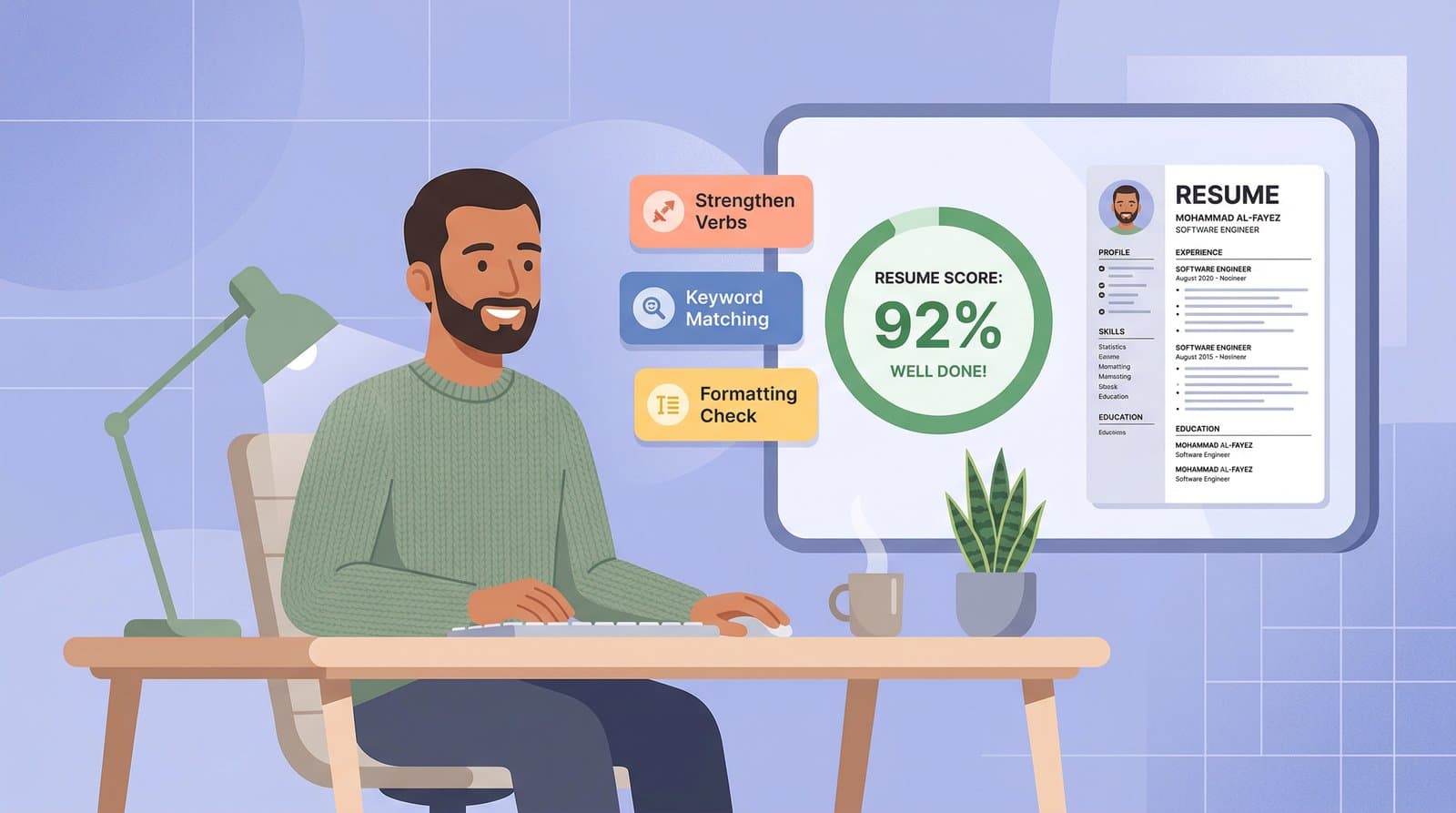
PrettyResume integrates resume scoring directly into the building process. As you create or update your resume, our ATS analysis feature grades your document in real time. You can watch your score climb as you make changes: adding missing keywords, strengthening bullet points, fixing formatting issues, all without leaving the editor.
The scoring is tied to your target job description. Paste the posting, and PrettyResume identifies the specific gaps between your current resume and that role's requirements. The AI bullet point generator then helps you fill those gaps with achievement-focused content that incorporates the relevant keywords naturally.
We built it this way because, in our experience, the back-and-forth between separate tools is where most people give up. When scoring and editing happen in one place, you're far more likely to actually hit that 80% threshold. Try PrettyResume's Resume Score free
Common Resume Scoring Mistakes
Only Checking Once
This one catches a lot of people. Your resume needs a fresh score for each application. A resume scoring 88% against one job description might score 62% against a different role at the same company. The keywords, requirements, and weightings change with every posting. According to SHRM, even similar-sounding roles at the same organization can have significantly different ATS configurations.
Optimizing Only for Score
Resume score checkers measure ATS performance, not human appeal. A resume optimized to score 95% might be so keyword-dense and formula-driven that a recruiter sets it aside on the first pass. Your goal is a score above 80% combined with content that reads well and sounds like a real person wrote it. This balance is tricky, though it gets easier with practice. For a full breakdown of the strategies that beat ATS systems in 2026, including how to balance optimization with readability, see our complete guide.
Ignoring Formatting Issues
Job seekers often focus exclusively on keyword gaps and overlook the formatting flags. A resume with perfect keyword coverage but a two-column layout that confuses the parser will still perform poorly in ATS screening. Formatting fixes are often the quickest wins in score improvement, and they're the easiest to miss.
Treating the Score as a Guarantee
Let's be honest: a high resume score gets you past the ATS filter and into a human reviewer's queue. It doesn't guarantee an interview. The recruiter still needs to see qualifications that genuinely match the role. Resume scoring is a prerequisite, not a shortcut. Results vary depending on the role, the company, and the competition.
Resume Score vs. Resume Worded vs. Jobscan: What's Different
Several dedicated ATS checking tools exist, and the right choice depends on your workflow:
Jobscan is the most established, with detailed keyword analysis and compatibility reports. It's reliable for analysis but doesn't include a resume builder, so you're always switching between where you analyze and where you write.
Resume Worded focuses on content quality feedback in addition to ATS scoring, rating factors like achievement quality and clarity. It offers limited free checks.
ResumeAI and similar tools provide varying levels of analysis quality. Some are primarily lead generation tools with surface-level scoring.
PrettyResume's Resume Score is integrated directly into the resume builder. You don't need a separate tool; score checking is part of the creation process. Based on resumes analyzed through our platform, this integrated approach means users optimize and score simultaneously rather than running separate workflows. For a broader look at how AI-powered builders compare to writing on your own, see our AI resume builder vs. writing your own comparison.
For job seekers who want building and optimizing to happen in the same place, PrettyResume offers the most streamlined approach. That said, if you already have a resume you're happy with and just need a quick ATS check, a standalone tool like Jobscan works fine too.
Related Articles
- How to Beat ATS Systems in 2026: The Complete Guide
- Why Most Resumes Get Rejected in 6 Seconds (And How to Fix Yours)
- Best Free AI Resume Builders in 2026 - Honest Comparison
- The 2026 Tech Resume Template: What Hiring Managers Actually Want
Frequently Asked Questions
What is a good resume score?
A resume score above 80% is generally considered strong. Scores in the 85 to 95% range indicate excellent keyword alignment and formatting compatibility with most ATS systems. Scores below 60% suggest significant formatting or keyword issues that should be addressed before applying. Scale.jobs data shows that candidates scoring above 80% receive 3x more interview requests than those below 60%.
How does a resume score checker work?
A resume score checker compares the content of your resume against a target job description using text analysis. It identifies keyword matches and gaps, evaluates formatting compatibility for ATS parsing, assesses section completeness, and scores your document on an overall match scale. The result tells you how well your resume would rank in a typical ATS system for that specific role.
Does a high resume score guarantee an interview?
No. A high resume score improves the probability that your resume will be seen by a human recruiter; it gets you past the algorithmic filter. After that, a human evaluates whether your qualifications and presentation merit an interview. Resume scoring is an important first hurdle, not the whole game.
How often should I check my resume score?
Every time you tailor your resume for a new application. Since each job description has different keywords and requirements, your score for one role doesn't predict your score for another. Building the habit of checking before every submission significantly improves your application performance over time.
Is PrettyResume's Resume Score free?
Yes. PrettyResume's Resume Score feature is available on the free tier. You can build your resume, score it against a target job description, and identify improvement areas without a paid plan. Start for free at PrettyResume.com