
Why You're Sending 100 Applications and Hearing Nothing Back
If you’re sending dozens of job applications and getting no interviews, the problem usually isn’t your talent. It’s a generic, untailored resume that disappears in ATS filters and hiring-manager inboxes. PrettyResume helps you turn one skills-based profile into multiple tailored, ATS-optimized resumes so you get more callbacks with fewer, higher-quality applications instead of spraying 100 identical resumes into the void.
prettyresume-blog-application-black-hole-final.md
Page 1 / 1 100%
Why You're Sending 100 Applications and Hearing Nothing Back
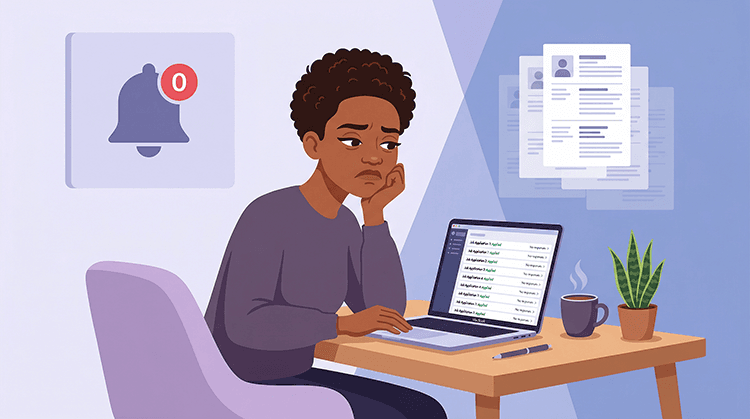
You rewrote your resume. You spent an entire Sunday afternoon on it. Maybe you even ran it through one of those free checkers online. And then you started applying. Ten jobs. Twenty. Fifty.
Nothing.
Not a rejection. Not a "we went with someone else." Just... silence.
If that sounds familiar, you're not imagining things. A recent report from Criteria found that 53% of job seekers experienced ghosting within the past year, a three-year high. And according to CoverSentry's analysis of candidate experience data, 77% of applicants report being ghosted after applying, with 75% never receiving any response at all.
So no, it's not you. But there are real reasons this is happening, and most of them have nothing to do with your qualifications.
The Math Is Brutal, but It's Not Random
Here's the part that actually matters: the average job seeker needs about 42 applications to land a single interview, with only about 2.4% of applicants reaching the interview stage for any given role. Employers are receiving an average of 250 applications per job posting. Entry-level roles? Often north of 400.
That means roughly 244 out of 250 people who apply for a given job will never hear back. Those are terrible odds. But here's the thing: those numbers represent the average across all applicants, including the people sending the same untouched resume to every opening they find.
When you look at people who actually tailor their resume to each role, the picture changes. A lot.
The One Thing That Actually Doubles Your Chances
There's a data set from Huntr that gets passed around career forums, and for good reason. They analyzed real job application data and found that tailored resumes achieved a 5.95% interview rate, compared to 2.9% for generic ones. That's roughly double the odds, just from customizing your resume to match the job description.
A separate study by ResumeGo found that candidates who customized their resumes were 31% more likely to land an interview compared to those who sent a generic version. And when they tested cover letters? Tailored cover letters resulted in 50% more interviews.
Meanwhile, a Scale.jobs analysis of 15,000 applications showed that resumes optimized for ATS compatibility hit an 11.7% callback rate versus just 4.2% for generic resumes. That's nearly a 3x difference.
The pattern is clear. Tailoring works. The problem is that most people don't do it because, honestly, it's exhausting.
Why Nobody Actually Tailors Their Resume
Let's be real about this. If you're applying to 10 jobs a week (which is a fairly standard recommendation for active job seekers), tailoring each resume means:
- Reading each job description carefully
- Identifying the key skills and keywords the employer is looking for
- Rewriting your summary to reflect those priorities
- Adjusting your bullet points to emphasize the most relevant experience
- Making sure the language matches what the ATS is scanning for
- Doing a final check to make sure everything still reads well
That's 30 to 45 minutes per application, if you're experienced at it. For 10 applications a week, that's five to seven hours just on resume customization. Not job searching. Not networking. Not interview prep. Just reformatting and rewording the same document over and over.
So what happens? People cut corners. They send the same resume everywhere and hope for the best. According to research cited by Resumly, 54% of candidates don't tailor their resume at all. And we already know what happens to those applications.
This is the real bottleneck in most job searches. Not a lack of effort. Not a lack of qualifications. The sheer time cost of doing the one thing the data says actually works.
The AI Resume Problem (and Why ChatGPT Won't Save You)
At this point, you might be thinking: "I'll just throw my resume into ChatGPT and have it tailor everything for me." And you wouldn't be alone. According to Resume Now's 2025 AI and the Applicant Report, 57% of hiring managers have seen a noticeable uptick in AI-assisted submissions over the past year. Candidates are absolutely using AI to write resumes. The problem? They're all using it the same way.
And hiring managers have noticed.
A Robert Half survey from March 2026 found that 65% of hiring managers say the surge in AI-enhanced resumes has made it harder to verify candidate skills. Not harder because the resumes are bad, exactly. Harder because they all sound the same. When a thousand applicants run the same job description through the same generic prompt, you get a thousand resumes that read like they were written by the same person. Same structure. Same buzzwords. Same hollow phrasing.
The result? Hiring managers can't meaningfully rank nearly half the resumes they receive. They all hit the same keywords, mirror the same job description language, and offer zero evidence of actual skill. A Resume Genius survey of 1,000 hiring managers found that 69% believe resumes have become more generic and formulaic over the past five years, and nearly 80% say they can now spot an AI-generated resume on sight. The top giveaways? Unnatural tone (51%), repetitive or generic phrasing (44%), and vague or exaggerated descriptions (41%).
This is a real problem, and it's getting worse. 90% of employers now report an increase in low-effort or spammy applications, largely driven by AI tools. And 62% say AI-generated resumes without personalization are more likely to be flat-out rejected.
So the people who thought they were saving time by pasting their resume into a chatbot? Many of them are actually hurting their chances. The AI-slop resume has become its own category of rejection.
What Your Resume Is Up Against
There's another layer to this that most job seekers don't think about. Before a recruiter reads your resume (if they read it), it has to pass through an Applicant Tracking System. Nearly every major employer uses one.
Now, the popular claim that "75% of resumes are rejected by ATS" has been debunked as having no real research behind it. The actual situation, according to interviews with 25 recruiters across 10+ ATS platforms, is that 92% of ATS systems don't auto-reject resumes based on content. They rank and sort.
But here's why that distinction barely matters in practice: when 250 people apply and a recruiter only looks at the top 20 ranked resumes, being ranked #150 is functionally the same as being rejected. Your resume was never seen.
What actually gets you ranked higher? Keyword alignment with the job description. Clear formatting that the system can parse. A structure that makes your skills and experience easy to match against the role's requirements.
In other words, the same tailoring we just talked about. But done in a way that sounds like you, not like every other applicant who ran the same prompt.
The Real Cost of a Stale Resume
There's a human cost here that the statistics don't fully capture. A survey from Express Employment Professionals and Harris Poll found that 58% of job seekers expect finding work in 2026 to be harder than ever. The median time to a first offer has climbed to about 68.5 days.
That's over two months of applications, waiting, and silence. Two months of checking your email, refreshing job boards, and wondering whether your resume even made it through. That kind of sustained uncertainty wears people down. And when you're demoralized, the quality of your applications slips, which creates a cycle that's hard to break.
The frustration is so widespread that only 43% of workers even plan to job search in 2026, down from 93% the year before, according to a Monster survey. People aren't staying at their jobs because they love them. They're staying because the process of finding something better feels impossible.
So What Actually Fixes This?
If the data tells us anything, it's that the quality of each individual application matters far more than the quantity. Sending 100 generic resumes will always lose to sending 25 tailored ones. And sending 25 AI-slop resumes that all read the same way isn't much better. The interview math backs this up consistently.
The challenge has always been time, and now there's a second challenge: standing out in a sea of AI-generated sameness. You need tailoring that actually reflects your unique experience, not a chatbot regurgitating the job description back at the recruiter.
This is exactly why we built PrettyResume.
PrettyResume is a skills-based career platform, and it works differently from pasting your resume into a generic chatbot. The AI model behind PrettyResume was trained specifically for resume and career content. It's not a general-purpose language model trying to do everything from writing poetry to debugging code. It was built to understand how hiring managers evaluate resumes, how ATS systems rank candidates, and how to translate real experience into skill-based language that actually stands out.
That distinction matters. When you use a generic LLM, it pulls from the same patterns everyone else gets. That's why hiring managers are seeing thousands of resumes with identical phrasing. PrettyResume's AI works from your actual skills profile, not a one-size-fits-all prompt. It generates bullet points grounded in your real experience, scores your resume against specific job postings, and flags gaps before you hit submit. The output reads like something you wrote because it's built from what you actually did.
And because PrettyResume is designed around a skills-first approach, every resume you create naturally speaks the language that 83% of recruiters say they're looking for: a clear match between what the job requires and what you bring to the table. Not keyword stuffing. Not recycled ChatGPT prose. Actual evidence of fit.
What This Looks Like in Practice
Say you're applying to a project management role and a product operations role in the same week. With a traditional resume, you'd either send the same document to both (and probably land in the bottom half of the ATS ranking for at least one), or spend an hour reworking each version. With ChatGPT, you'd get two resumes that hit the right keywords but sound exactly like the 200 other AI-assisted applications in the pile.
With PrettyResume, you'd pull from the same skills profile and let the platform tailor each version to the job description. The project management resume highlights your planning, stakeholder communication, and delivery track record. The product ops version emphasizes your cross-functional coordination, data analysis, and process improvement work. Same career, same experience, but framed in a way that sounds like you and speaks to what each hiring manager is looking for.
Not sure where to start? PrettyResume also offers role-specific resume guides for dozens of job titles, from Software Engineer to Project Manager to Registered Nurse. Each one is ATS-optimized and vetted by career experts, so you're not starting from a blank page or a generic template that every other applicant downloaded.
That's the difference between sending 100 resumes and hearing nothing, and sending 20 that actually land.
The Bottom Line
The job market in 2026 is not kind to people who spray and pray. And it's becoming actively hostile to people who let a chatbot write their resume without putting any of themselves into it. The data is clear: generic applications get ignored, and the silence isn't personal. It's structural.
But the fix isn't complicated. Tailor your resume. Speak the language of the job you want. Make sure your formatting works with the systems that stand between you and a recruiter. And make sure your resume sounds like a person, not a prompt.
And if the idea of doing that 10 or 20 times a week feels overwhelming, that's exactly the problem PrettyResume was built to solve. A free tier gets you started. If you want AI-powered optimization from a model that was actually built for this, the Core plan is $9/month and Pro is $20/month. Either way, you'll spend less time reformatting and more time actually preparing for the interviews that start showing up.
Because they will show up. The data promises that, too. Displaying prettyresume-blog-application-black-hole-final.md.