
Skills-Based Hiring Is Here: What It Means for Your Resume in 2026
Skills-based hiring is transforming how employers find talent. Learn what the shift means for job seekers and how to build a skills-based resume that gets noticed in 2026.

Skills-Based Hiring Is Here: What It Means for Your Resume in 2026
If you've been job searching recently, you already know the feeling. You send out 100, 150, even 200 applications. You tailor cover letters. You tweak bullet points. And then... silence. The data backs up what your inbox already tells you: only 0.1% to 2% of cold applications result in job offers, according to HiringThing. Recruiters spend six to seven seconds on an initial resume scan, per research from Indeed and the Tufts Career Center. The system feels broken for everyone.
But something big is shifting. The way employers evaluate talent is fundamentally changing, and for the first time in decades, the change actually benefits job seekers. It's called skills-based hiring, and it's not a buzzword or a pilot program. It's the new operating system for talent acquisition. Understanding this shift and positioning yourself for it may be the single most important thing you can do for your career in 2026.
The Rise of Skills-Based Hiring
Skills-based hiring means evaluating candidates on demonstrated skills and competencies rather than degrees, job titles, or years of experience. The shift is already mainstream.
According to NACE's Job Outlook 2026 survey, 70% of employers now use skills-based hiring, up from 65% the prior year. And it's working. SHRM reports that skills-first practices reduce cost-per-hire by up to 30% and cut turnover by over 40%. LinkedIn's data shows it expands talent pools by 15.9x in the United States alone.
The credential barrier is falling too. One in four employers eliminated bachelor's degree requirements by the end of 2025, according to Higher Ed Dive. GPA screening dropped from 73% of employers in 2019 to just 42% today. The World Economic Forum's Future of Jobs Report estimates that 39% of existing skill sets will be transformed or outdated by 2030. The message is clear: what you can do matters more than where you went to school.
Why the Old Resume Doesn't Work Anymore
The traditional resume is a chronological list of job titles and duties. It was built for a world where employers screened by pedigree: the right degree from the right school, a recognizable employer name, and enough years in the seat. That world is fading fast.
When 70% of employers prioritize skills over credentials, a resume that leads with "Company X, 2019-2023" instead of "what I can actually do" is speaking the wrong language. It's like writing your cover letter in English for a company that now reads French. The content might be great, but it's not getting through.
The problem gets worse when you factor in AI. Generative AI tools have flooded the application market with polished but generic, cookie-cutter resumes. Recruiters now see an average of 242 applications per opening, with way more look-alike resumes competing for attention. The signal-to-noise ratio is at an all-time low.
Applicant Tracking Systems (ATS) were supposed to help, but they often make things worse. ATS platforms rank and filter by keyword match, and keywords without skill evidence are just noise. If your resume says "project management" but never demonstrates it with a concrete outcome, you're playing keyword bingo, not proving your value.
The bottom line: the old resume format was built for a hiring model that's being replaced. If you're still using it, you're competing with one hand tied behind your back.
What a Skills-Based Resume Actually Looks Like
So what does a skills-based resume look like in practice? It's not about adding a bigger skills section at the bottom. It's a fundamentally different way of organizing your professional story. Here's how to make the shift:
Lead with skills, not chronology. Your skills section isn't an afterthought. It's the headline. Place your core competencies at the top of the resume, organized by skill category. This gives recruiters and ATS systems an immediate map of your capabilities before they ever see a company name or date range.
Map every bullet to a job requirement. Every bullet point in your experience section should demonstrate a skill the employer actually listed. If a job posting asks for "cross-functional collaboration" and "data analysis," your bullets should show those skills in action, not just list duties you happened to perform.
Evidence over claims. "Managed a team" says nothing. "Led a cross-functional team of 8 to deliver a $2M product launch 3 weeks ahead of schedule" proves leadership, project management, and execution. Every claim needs proof: a number, an outcome, a before-and-after. This is what we call proof of fit, which is concrete evidence that you can do the specific work the role requires.
Use the O*NET framework as your skill vocabulary. The U.S. Department of Labor's ONET database maps 35 core skills across 1,000+ occupations. It's the shared language employers increasingly use to define roles. Aligning your resume language with ONET categories means you're literally speaking the same skill vocabulary as the people reading your resume.
Kill the objective statement. Replace it with a skills summary that mirrors the job description's requirements. Objective statements are about what you want. Hiring managers care about what you can deliver. A skills summary that reflects the role's needs tells the reader, in the first three lines, why they should keep reading.
Enter the Skills-Based Career Platform
Here's the gap in the market that most job seekers don't see: the tools available to them haven't kept up with how hiring actually works now.
Most resume builders still treat resume creation as a formatting exercise. They give you templates and let you type. That's like giving someone a blank canvas and calling it art school. The template is the easy part. The hard part, understanding which skills matter for a role, how to articulate them, and whether your profile is actually competitive, is left entirely to you.
A skills-based career platform does something fundamentally different:
- AI-powered skill extraction and mapping. Instead of asking you to type in keywords, it analyzes your experience and extracts the skills you actually have, then maps them against real job requirements. This isn't keyword stuffing. It's skill alignment.
- Proof-of-fit scoring. Before you apply, you can see how your skills align with a specific role. Think of it as a pre-flight check for every application, so you invest your energy where you have the highest probability of success.
- Persistent skills profiles. Your skills persist across every resume you create, building a career-long asset rather than a one-time document. Over time, you develop a living map of your capabilities that grows with every role and project.
- ATS optimization grounded in skill relevance. Optimization based on genuine skill alignment to the role, not keyword gaming that produces hollow matches.
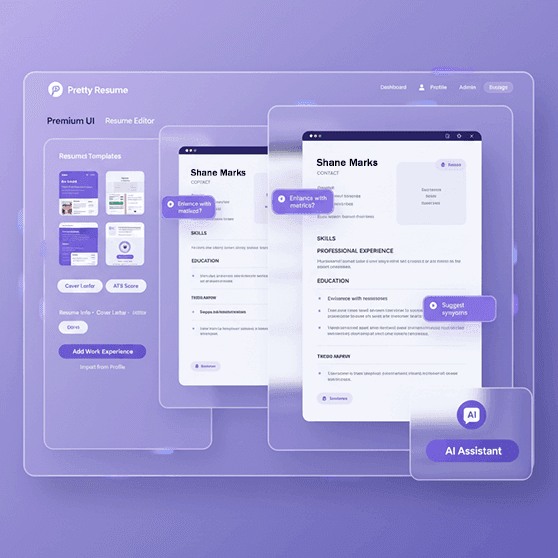
PrettyResume was built for exactly this moment. We didn't pivot to skills-based hiring. We were built around it. Every resume our platform creates starts with skills extraction and job-specific alignment. That's not a feature we added. It's the foundation.
If you want to see what a skills-based resume looks like for your next role, try PrettyResume free at prettyresume.com.
What This Means for Your Career, Not Just Your Next Job
Skills-based hiring isn't just about getting past ATS filters or landing your next interview. It's about career mobility: the ability to move across roles, industries, and levels based on what you can do, not where you've been.
The data here is striking. LinkedIn found that skills-based hiring opens 15.9x more opportunities in the U.S. alone. Workers without traditional four-year degrees benefit even more, experiencing a 6.3x talent pool expansion compared to 5.9x for degree holders. For the first time, the playing field is genuinely leveling.
And it's not just about access. According to Revelio Labs data cited by iMocha, employees hired through skills-based processes stay 34% longer in their roles. That's because skills alignment isn't just good for hiring. It's good for job satisfaction. When you're hired for what you can actually do, you're more likely to succeed and stay engaged.
The takeaway is simple: building and documenting your skills isn't just a resume tactic. It's a career strategy that compounds over time. Every project, every cross-training opportunity, every new tool you master adds to a skills portfolio that follows you throughout your career.
The future belongs to people who can articulate what they can do, not where they've been.
The Time to Adapt Is Now
The skills-based hiring wave isn't coming. It's here. Seventy percent of employers are already using it. Degree requirements are being dropped. GPA screening is fading. AI is rewriting how applications are evaluated. The question isn't whether to adapt. It's how fast.
Whether you're actively job searching today or planning your next career move, starting with your skills is no longer optional. It's the new baseline. The job seekers who thrive in this new landscape will be those who can clearly map their skills to what employers need, with evidence, specificity, and a format that speaks the language of modern hiring.
PrettyResume is the skills-based career platform built to help you lead with what you can do. Start building your skills-based resume today, free at prettyresume.com.
Sources
- NACE, "Employer Use of Skills-Based Hiring Practices Grows," Job Outlook 2026. https://www.naceweb.org/job-market/trends-and-predictions/employer-use-of-skills-based-hiring-practices-grows
- iMocha, "Skills-Based Hiring Trends". https://www.imocha.io/blog/skills-based-hiring-trends
- SHRM, "Skills-First Hiring Advances Career Mobility". https://www.shrm.org/topics-tools/news/talent-acquisition/skills-first-hiring-advances-career-mobility-paper-ceiling
- World Economic Forum, "Skills-Based Hiring: Jobs of the Future". https://www.weforum.org/stories/2025/03/skills-based-hiring-jobs-future/
- LinkedIn Economic Graph, "Skills-Based Hiring" (March 2025). https://economicgraph.linkedin.com/content/dam/me/economicgraph/en-us/PDF/skills-based-hiring-march-2025.pdf
- Higher Ed Dive, "Employers Eliminating Degree Requirements". https://www.highereddive.com/news/employer-eliminate-degree-requirements-2025/749061/
- Indeed, "How Long Do Employers Look at Resumes". https://www.indeed.com/career-advice/resumes-cover-letters/how-long-do-employers-look-at-resumes