
PrettyResume vs Rezi: Which ATS Resume Builder Is Better in 2026?
Rezi built everything around beating ATS software. PrettyResume was built on the belief that your resume should also impress the human on the other side. Here's an honest side-by-side of pricing, AI quality, templates, and ATS tools to help you pick the right one.

PrettyResume vs Rezi: Which Resume Builder Actually Gets You Interviews in 2026?
You've been applying for weeks. Your resume looks fine to you, but it's disappearing into the void. So you start researching resume builders and quickly land on two names: Rezi and PrettyResume. Both claim to be ATS-friendly. Both use AI. Both promise more callbacks.
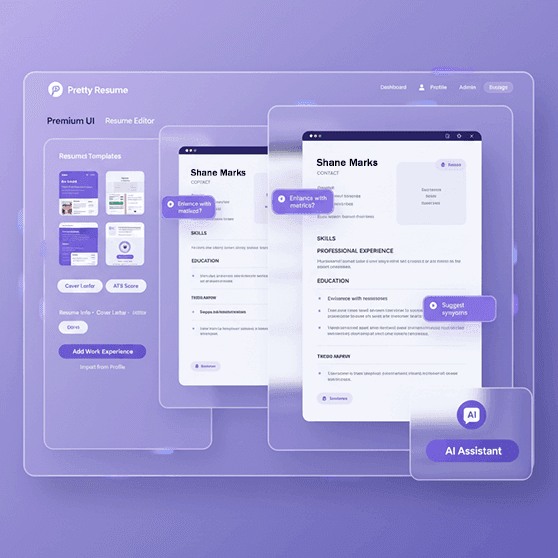
The problem is they were built on completely different philosophies — and picking the wrong one for your situation will cost you time, money, and possibly interviews. One tool was built to make your resume invisible to robots in the best possible way. The other was built on the belief that a resume also has to impress a human on the other side.
This post walks through both tools honestly. Where Rezi is genuinely better, we'll say so. Where PrettyResume wins, we'll explain why. The goal is to help you pick the right tool, not to sell you something you don't need.
Quick Overview
Rezi launched in 2017 as an ATS-first resume builder. Their core thesis is simple: most resumes never reach a human because ATS software rejects them first. So Rezi built everything around beating that software — clean single-column templates, a 23-checkpoint scoring system, real-time keyword analysis against job postings. They have over 4 million users and a genuine reputation in the ATS space. If you ask on Reddit what to use for ATS optimization, Rezi comes up constantly.
PrettyResume was built by a creative director who got tired of watching great candidates lose to worse resumes. The premise is different: ATS compatibility and good design are not mutually exclusive. PrettyResume focuses on templates that look polished on a recruiter's screen while still parsing cleanly through ATS systems, paired with AI that builds from your actual skills profile rather than generic prompts. It's newer than Rezi, but it's growing fast among career switchers, creative professionals, and anyone tired of resumes that look like they were made in 2009.
Pricing Comparison
Here's a side-by-side of what you actually pay:
| Plan | Rezi | PrettyResume |
|---|---|---|
| Free | $0 — 1 resume, 3 PDF downloads, limited AI | $0 — 2 resumes, basic AI |
| Core / Pro (monthly) | $29/mo — unlimited resumes, full AI, 1 human review/mo | $9/mo — 25 resumes, advanced AI, resume score, adjustable layouts |
| Pro / Unlimited | — | $20/mo — unlimited everything, LinkedIn import, priority support |
| Lifetime | $149 one-time — all Pro features minus human review | — |
A few things to note. Rezi's monthly Pro plan at $29/mo is steep — that's above most comparable tools on the market, as Resume Genius notes in their Rezi review. PrettyResume's Core plan at $9/mo is roughly a third of that price and covers most of what the average job seeker needs. The Core plan also includes adjustable layouts and a live resume score — features you'd have to upgrade to access on Rezi.
Rezi's $149 lifetime plan is legitimately good value if you're a freelancer, contract worker, or someone who job hunts regularly. Pay once, keep access forever. The math works after about five months of Pro usage. The catch is that $149 is a real ask when you're between jobs. For someone actively job searching with limited runway, committing that upfront is a hard sell. It also excludes the monthly human review, which costs an extra $8 per session on the Lifetime plan.
PrettyResume's pricing stays accessible throughout the job search. At $9/mo for Core, you're not breaking the bank while you're waiting for callbacks. And if you want everything unlocked — unlimited resumes, LinkedIn import, priority support — the Pro plan at $20/mo is still $9 less per month than Rezi's equivalent.
ATS Optimization
Both platforms take ATS seriously. That said, Rezi has more years of iteration here, and it shows.
Rezi's ATS feature set is deep: real-time keyword analysis when you paste in a job description, a Rezi Score that checks 23 criteria including action verb strength, bullet length, quantification, and formatting consistency. Enhancv's review calls their keyword targeting a genuine differentiator for experienced professionals who need to tailor a resume to specific postings quickly. The feedback is gamified in a way that actually reduces anxiety — you can see exactly what to fix. The Rezi self-assessment notes that their survey respondents cited professional formatting and the Rezi Score as the top reasons the platform works for them.
PrettyResume's Resume Score tool provides real-time ATS feedback with actionable suggestions as you build. It flags missing keywords, formatting issues, and section gaps. For most job seekers, it covers everything that matters.
One fair criticism of Rezi's scoring: Resume Genius found that the Rezi Score is easy to game by making surface-level edits like punctuation fixes, without necessarily improving the resume's persuasiveness. A high score doesn't automatically mean a strong resume. That's worth keeping in mind if you're treating the number as a proxy for quality.
The honest comparison: Rezi's ATS tooling is more granular. If you're obsessively optimizing for a specific role at a specific company and want to audit every potential ATS failure point, Rezi gives you more knobs to turn. PrettyResume's scoring is thorough and practical, but it doesn't go quite as deep on the diagnostic side.
If ATS depth is your single biggest concern, Rezi earns the edge in this category.
AI Writing Quality
This is where the comparison gets interesting — and where the reviews tell a consistent story.
Across Trustpilot, Resume Genius, Enhancv, and independent developer reviews on DEV.to, the same complaint surfaces again and again about Rezi's AI: the output sounds generic. One Trustpilot reviewer described it as content that "creates metrics out of thin air" and "constantly uses cliche terms." Another noted it "sometimes yields falsified info." The Resume Genius review put it plainly: the AI produces bullet points that read like job descriptions, not achievements — and it occasionally strips out positive outcomes from user-written content when editing.
Rezi themselves, in a self-assessment post, acknowledge the AI can feel "rigid, repetitive, hit-or-miss" and that it "falls short vs. standalone LLMs in AI content quality." That's an honest admission, and credit to them for making it. They also note that the AI works better as a starting point than a finished product, which is true — but that's a lot of manual cleanup at $29/mo.
The DEV.to review from a senior front-end developer found that the AI interview questions were too generic for a technical role, and the summary writer produced results that felt "strange." For experienced professionals, the AI doesn't always have enough context to write at the right level.
PrettyResume's AI works differently. Instead of running generic prompts against a job title, it builds from your skills profile — the specific experience, tools, and context you've entered. The output is designed to sound like something you'd actually write about yourself, not something a bot scraped from a job listing. Career switchers find this especially useful because the AI helps reframe skills across industries without making up numbers. You're not starting from a blank template with a job title typed in; the AI actually knows what you've done.
No AI writing tool is perfect. You'll always refine the output. But there's a meaningful difference between AI that gives you a first draft you can work with and AI that gives you something you need to mostly rewrite.
Design and Templates
This is PrettyResume's clearest advantage, and it's not subtle.
Rezi has five templates. They are all single-column. They are minimal on color. Rezi's own blog describes them as intentionally plain — trading visual flair for ATS compatibility. On Reddit, users describe Rezi resumes as "ugly but effective." The Enhancv review puts it this way: "To a human recruiter, a Rezi resume looks like a plain text document. It lacks the 'pop' of a two-column design."
Rezi's philosophy is that design doesn't matter if you can't get past the robots. Our take: you can do both.
PrettyResume was built by someone who cares about what a resume looks like when it lands on a desk. The templates are designed to hold up visually while still parsing cleanly through ATS. Two-column layouts that don't confuse parsers. Color palettes that look professional rather than garish. Typography that makes it easier for a human to scan quickly. If you're applying to roles where the hiring manager actually looks at your resume — which is most roles — the visual presentation matters.
You can browse the range of PrettyResume templates by job title to see what that looks like in practice for your specific field.
Who Should Pick Which
Pick Rezi if:
- You work in a conservative field — finance, law, government, large enterprise — where plain resumes are the norm and recruiters are skeptical of anything that looks designed
- You want the lifetime deal and you're a frequent job seeker or freelancer
- Maximizing ATS diagnostic depth is your primary goal
- You don't mind doing significant manual editing on AI output
- You already have strong resume content and just need ATS scoring and keyword alignment
Pick PrettyResume if:
- You want your resume to look good and pass ATS — not one or the other
- You're a career switcher who needs skills-based framing rather than direct title-to-title matching
- You want simpler, more affordable pricing while you're actively searching
- You care about AI output that sounds like a person wrote it, not a job posting
- You're applying to companies where a recruiter will actually look at your resume on screen
- You want a broader range of templates that fit your field and personality
The Bottom Line
Rezi is a real product built by people who understand the ATS problem. Its scoring system is genuinely useful, its lifetime plan is legitimately good value for the right user, and its reputation in the ATS space is earned. If you want the most granular ATS tooling available and you're okay with plain-looking output, it's a solid choice.
But there's a question underneath all of this: do you believe a resume can be both beautiful and effective? Rezi's answer is essentially no — pick ATS safety and sacrifice the rest. We built PrettyResume because we think that's a false choice. Most hiring still involves a human being at some point. When your resume gets through the ATS and lands in front of that person, it should be worth looking at.
Both tools are serious. The right one depends on what you value — and what the companies you're targeting are actually looking for.
Looking for templates tailored to your role? Browse PrettyResume by job title to find a starting point that fits your field.